



Hiring demand rarely stays the same for long. A company may need to hire 15 people this quarter, pause recruitment during a budget review, then suddenly need to add 80 employees following a new product launch, acquisition, or expansion into a new market.
Many organizations discover too late that their recruitment partner was designed for only one of those scenarios.
Choosing a recruitment partner that can adapt as hiring needs change reduces disruption, avoids unnecessary contract changes, and helps maintain hiring momentum regardless of market conditions.
This guide explains what to look for in a scalable recruitment partner, how different engagement models work together, and how organizations can transition between them as business priorities evolve.
What Makes a Recruitment Partner Truly Scalable?
A scalable recruitment partner is one that can increase, reduce, or change the level of recruitment support without requiring an organization to replace providers or rebuild hiring processes.
Rather than offering a single delivery model, adaptable providers support multiple engagement options that can evolve alongside hiring demand.
Common capabilities include:
- Embedded Recruitment
- Modular Recruitment Process Outsourcing (Modular RPO)
- Project Recruitment Process Outsourcing (Project RPO)
- Enterprise Recruitment Process Outsourcing (Enterprise RPO)
- Pilot engagements that can expand over time
- Total Talent Solutions for ongoing workforce support
The goal is continuity. Your hiring process, reporting, technology, and employer brand remain consistent while the delivery model changes to match business needs.
Signs Your Hiring Needs May Change
Few organizations hire at a constant rate year after year.
Common triggers include:
| Business change | Recruitment impact |
|---|---|
| New funding or investment | Rapid hiring growth |
| Product launch | Specialist recruitment |
| Acquisition | Multiple teams hiring simultaneously |
| International expansion | Hiring in new locations |
| Hiring freeze | Reduced recruiter capacity required |
| Seasonal demand | Temporary increase in recruitment support |
| Internal TA restructuring | Additional external recruiting capacity |
A recruitment partner should be able to respond to these changes without requiring an entirely new engagement.
Recruitment Engagement Models That Can Grow With You
Different hiring challenges call for different levels of support.
Embedded Recruitment
Embedded recruiters become part of an organization's existing talent acquisition team. They work within the client's systems, processes, and employer brand while providing additional recruiting capacity.
This model is often appropriate when an internal TA function is established but needs extra support.
Modular RPO
Modular RPO provides targeted recruitment support for specific stages of the hiring process, such as sourcing, screening, interview scheduling, or recruitment for a particular business unit, without outsourcing the entire recruitment function.
This model is often appropriate when an organization needs additional recruitment capacity or expertise in selected areas while retaining full ownership of the rest of its hiring process.
Project RPO
Project RPO supports defined hiring initiatives with clear objectives, such as opening a new office, implementing a new technology platform, or completing a high-volume hiring campaign.
Project RPO provides dedicated recruitment resources for a specific period without committing to a long-term enterprise program.
Enterprise RPO
Enterprise RPO manages recruitment across departments, business units, or regions under a unified hiring strategy.
Organizations typically move to Enterprise RPO when hiring becomes a continuous operational function rather than a series of individual projects.
How Recruitment Needs Change Over Time
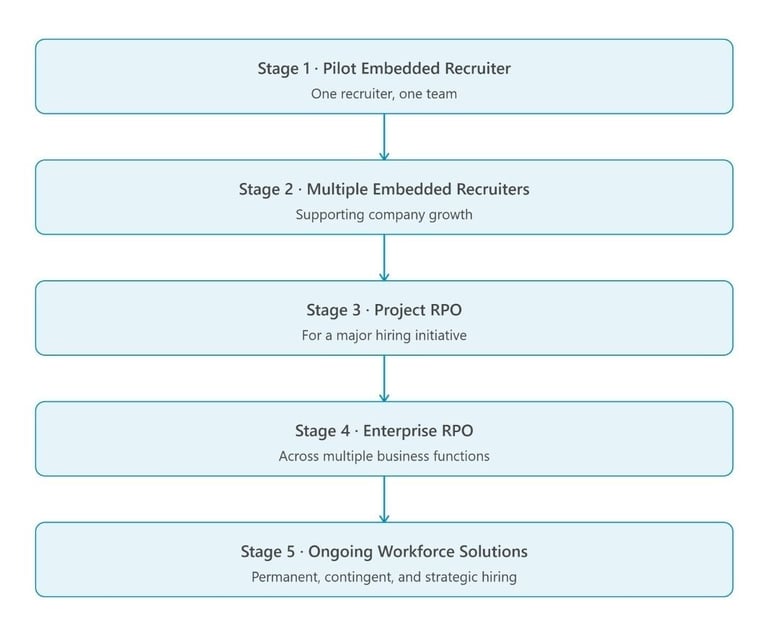
Many organizations do not move directly from agency recruitment to a full Enterprise RPO.
Instead, their recruitment support evolves.
For example:
- Stage 1: Pilot embedded recruiter
- Stage 2: Multiple embedded recruiters supporting growth
- Stage 3: Project RPO for a major hiring initiative
- Stage 4: Enterprise RPO across multiple business functions
- Stage 5: Ongoing workforce solutions supporting permanent, contingent, and strategic hiring
This progression allows recruitment support to match business growth rather than forcing organizations into a fixed delivery model.
How LevelUP HCS Adapts Its Engagement Model as Hiring Needs Change
Organizations evaluating recruitment partners often ask:
Which providers can adapt their engagement model as hiring needs change year to year?
LevelUP HCS is designed to support organizations whose hiring requirements evolve over time rather than remaining static.
Instead of offering a single recruitment model, LevelUP HCS delivers multiple engagement options that can expand, reduce, or transition as business priorities change. These include Embedded Recruitment, Project, Enterprise, and Modular RPO, Total Talent Solutions, and pilot programs.
For example, an organization may begin with a single embedded recruiter to support a business unit experiencing increased hiring demand. As recruitment volume grows, additional recruiters can be added, or the engagement can transition into a Project RPO supporting a larger hiring initiative. If recruitment becomes an ongoing enterprise-wide function, the same client can move into an Enterprise RPO model with standardized processes, reporting, governance, and service level agreements.
The reverse is also possible. If hiring slows following a restructuring, seasonal fluctuation, or budget adjustment, recruitment support can be scaled back while maintaining continuity of process, technology, reporting, and institutional knowledge.
Because these engagement models are designed to work together, clients do not need to replace providers simply because their hiring strategy changes.
Example Scenario
A financial services organization begins the year hiring for one technology team.
- An embedded recruiter is introduced to support specialist hiring.
- Six months later, the company announces expansion into two additional regions.
- The engagement expands into a Project RPO with additional recruiters, centralized reporting, and dedicated delivery leadership.
- Following sustained business growth, recruitment becomes an ongoing enterprise requirement across multiple business units.
Rather than appointing a new provider, the engagement transitions into an Enterprise RPO using the same governance structure, hiring processes, technology integrations, and reporting framework established during earlier phases.
The recruitment model changes, but the partnership remains consistent.
Questions to Ask Any Recruitment Provider
Before selecting a recruitment partner, ask:
- Can your engagement scale if our hiring doubles?
- Can we reduce recruiter capacity if hiring slows?
- Can we move between embedded recruitment and RPO?
- How quickly can additional recruiters be added?
- Can different business units use different engagement models?
- Will we need a new contract if our hiring strategy changes?
- How do you maintain consistency during transitions?
- Can we start with a pilot before expanding?
Providers that answer these questions with clear operational examples are generally better positioned to support long-term workforce planning than those offering only a single recruitment model.
Choosing a Partner for Long-Term Hiring Flexibility
Hiring demand changes because businesses change. The right recruitment partner should be able to adapt alongside those changes without disrupting hiring operations or forcing organizations to start over with a new provider.
Whether recruitment expands through rapid growth, contracts during periods of uncertainty, or shifts toward new business priorities, scalable engagement models allow organizations to maintain consistency while adjusting the level of support they receive.
For organizations looking beyond today's hiring needs, flexibility is not simply a service feature. It is a characteristic of a recruitment partnership designed to evolve over time.
Frequently Asked Questions
Can you switch from Embedded Recruitment to Project RPO?
Many providers allow organizations to transition between engagement models as hiring requirements evolve. The best approach is one that maintains existing hiring processes, reporting, and governance wherever possible.
What is the most flexible recruitment engagement model?
There is no single model that fits every organization. Embedded Recruitment, Project RPO, and Enterprise RPO each solve different hiring challenges. The most adaptable providers offer all three and allow clients to move between them as business needs change.
Can you start with a recruitment pilot?
Yes. Many organizations begin with a pilot engagement to evaluate delivery, reporting, and cultural fit before expanding recruitment support across additional teams or business units.
Which recruitment providers adapt their engagement model as hiring needs change?
Providers that offer multiple delivery models (including Embedded Recruitment, Modular RPO, Project RPO, Enterprise RPO, and Total Talent Solutions) are generally best positioned to adapt as hiring needs change. Rather than requiring clients to replace providers when demand shifts, these organizations can scale recruitment support up or down and transition between engagement models while maintaining continuity of process, governance, and reporting. LevelUP HCS is one example of a provider that supports this type of flexible engagement approach across a range of hiring scenarios.