


Manufacturing leaders do not need another reminder that talent is tight. Expansion timelines are slipping, production capacity is constrained, and hiring teams are under pressure to deliver highly skilled talent faster than the market allows. The reality behind many manufacturing hiring challenges is not just a shortage of candidates, but a series of bottlenecks that slow hiring at every stage of the process.
For organizations investing in new facilities, advanced production lines, or specialized capabilities, these bottlenecks carry real business consequences. Delays in hiring do not sit in HR dashboards. They show up as missed output targets, delayed go-lives, and increased operational risk.
Why the US Manufacturing Sector Is Facing Increased Fragility
Manufacturers are being asked to increase output without a corresponding increase in workforce capacity.
Recent market data reinforces how fragile this environment has become. U.S. manufacturing activity expanded in March at its fastest pace since 2022, yet input costs surged and supplier lead times lengthened due to geopolitical disruption. At the same time, factory employment continued to contract, reflecting hesitation to hire despite rising demand.
This combination creates a structural imbalance. Demand is increasing, but the systems required to support that growth are under strain.
Rising Costs Are Tightening Operating Flexibility
Input prices have climbed sharply, driven by energy market disruption and constrained global shipping routes. As costs increase, manufacturers are forced to operate with tighter margins and greater scrutiny over spending.
This has a direct impact on hiring. Even when demand justifies workforce expansion, leadership teams may slow hiring decisions to manage cost exposure and protect margins.
Supply Chain Disruptions Are Extending Timelines
Supplier delivery times have reached their highest levels in years, reflecting delays across global logistics networks. Materials and components are taking longer to arrive, which complicates production planning and reduces predictability.
When production timelines are already extended, hiring delays add another layer of risk. Workforce gaps can no longer be absorbed as easily when upstream dependencies are unstable.
Hiring Hesitation Is Creating a Capacity Gap
Despite increased production activity, many organizations remain cautious about adding headcount. Ongoing uncertainty around tariffs, geopolitical tensions, and long-term demand is causing delays in hiring approvals and slower decision-making.
This hesitation creates a disconnect between demand and workforce capacity. Organizations need to produce more, but the hiring process is not moving at the same pace.
The Result: Growth Without Execution Certainty
Taken together, these factors create a fragile operating environment where growth is possible, but execution is difficult. Manufacturing organizations are being asked to increase output while managing constraints across labor, supply chains, and cost structures.
This is where hiring delays become most visible. When workforce capacity cannot keep pace with production demand, even small bottlenecks in recruiting can have outsized operational impact.
The Real Scope of the Skilled Labor Shortage in Manufacturing
The skilled labor shortage in manufacturing is often discussed broadly, but the impact becomes more acute when organizations are hiring for roles tied directly to production performance, system optimization, and operational continuity.
These positions require:
- Hands-on experience in specific production environments
- Familiarity with specialized equipment or systems
- The ability to operate within highly regulated or precision-driven settings
Hiring teams are not just assessing qualifications on paper. They are evaluating whether candidates can operate effectively within complex, high-stakes environments.
As production activity expands across multiple sectors, the gap between demand and available talent becomes more visible. Many organizations are competing for the same limited pool of qualified professionals, which extends hiring timelines and increases pressure on internal teams. At this level, hiring delays are rarely about a lack of effort. They reflect how difficult it is to identify candidates who can meet both technical requirements and operational expectations within tight timelines.
Where Hiring Actually Breaks Down
Most hiring delays are not caused by a single issue. They come from friction across the entire hiring process. In advanced manufacturing, several bottlenecks consistently appear.
Narrow Talent Pools for Specialized Roles
Highly skilled manufacturing roles draw from a limited and highly competitive talent pool. Many qualified candidates are already employed, and few are actively applying to job postings.
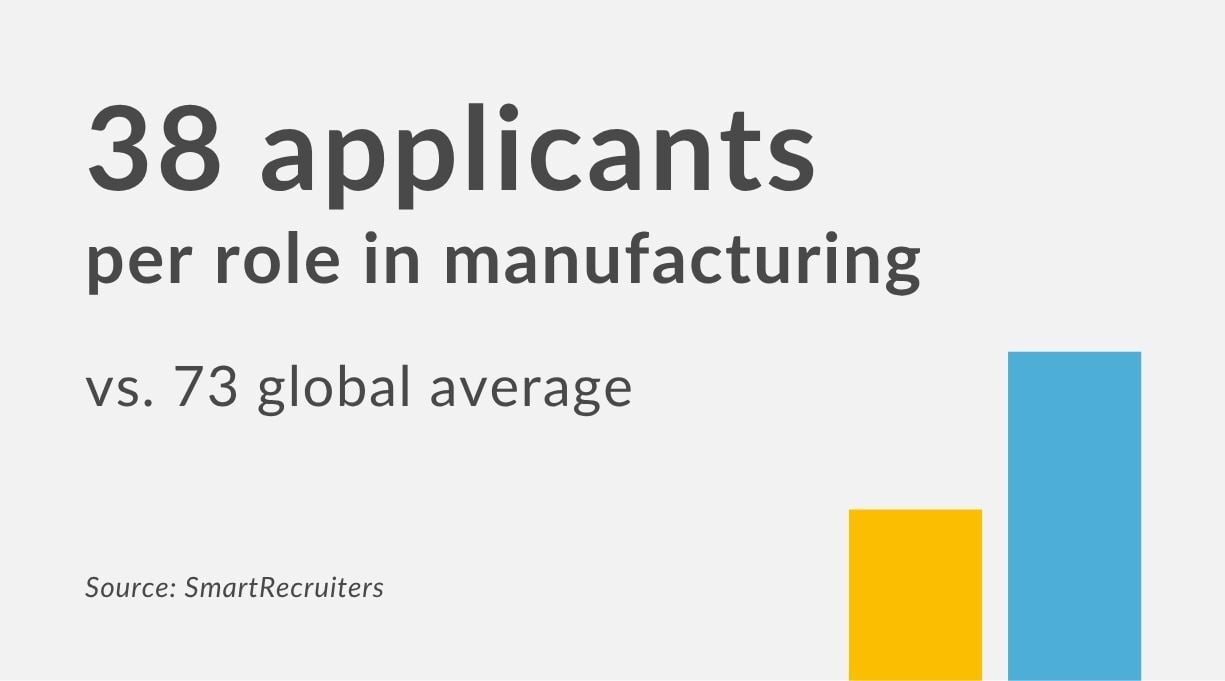
This dynamic is reflected in recruiting benchmarks. Manufacturing organizations average significantly fewer applicants per role than the global average, with roughly 38 applicants compared to 73. That gap highlights how constrained the top of the funnel is for specialized roles.
With fewer candidates entering the pipeline, every misstep in sourcing or screening has a greater impact on time-to-fill.
Misalignment Between Hiring Managers and Recruiters
In many manufacturing organizations, hiring requirements are not fully defined at the outset. Job descriptions outline responsibilities, but they often miss critical context around operational expectations and trade-offs.
Without alignment on what success looks like and where flexibility exists, recruiters may present candidates who meet the written requirements but not the practical need. This leads to rejected candidates, repeated searches, and extended hiring timelines.
For HR leaders managing consistency across business units, this misalignment increases process variability and adds pressure to already stretched teams.
Overreliance on Traditional Recruiting Channels
Job boards and internal databases remain common starting points, but they are rarely sufficient for high-skill manufacturing roles. Many organizations still depend heavily on these channels, which limits access to passive candidates.
The result is predictable: pipelines remain thin, and roles stay open longer than expected.
Expanding reach into passive talent markets requires dedicated sourcing efforts and industry-specific networks. Without this, hiring teams are competing for the same visible candidates as everyone else.
Limited Recruiting Capacity During Peak Hiring Periods
Expansion projects and new facility launches create sudden spikes in hiring demand. Internal recruiting teams are rarely built to absorb these surges.
Instead, teams are forced to stretch existing capacity across a higher volume of requisitions. This leads to slower response times, reduced engagement with hiring managers, and delays in coordination.
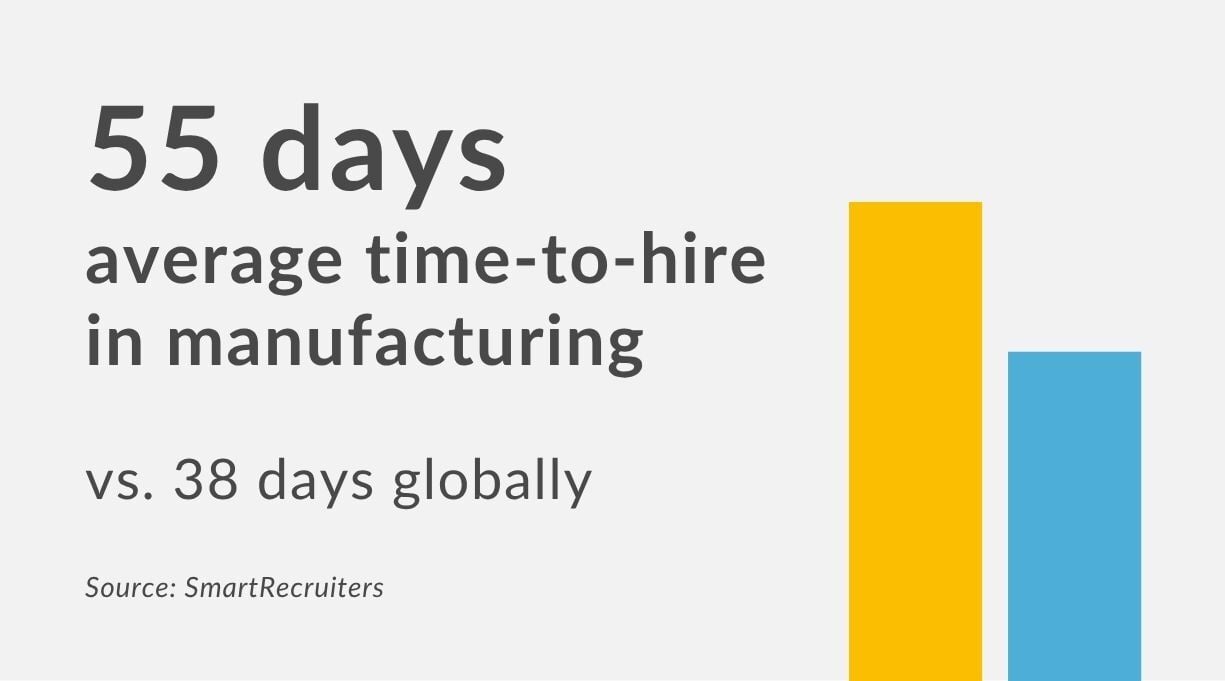
Benchmark data reinforces this challenge. Manufacturing time-to-hire averages around 55 days compared to 38 days globally, a 45 percent difference. This gap reflects both market constraints and internal capacity limitations.
When hiring timelines extend this far, project milestones begin to slip.
Slow Decision-Making and Interview Cycles
Even when qualified candidates are identified, hiring timelines often extend due to internal processes. Multiple interview rounds, delayed feedback, and competing stakeholder priorities slow decision-making.
In a competitive market, strong candidates do not stay available for long. Delays at this stage often result in lost offers and restarted searches.
This issue is often tied to broader uncertainty. As manufacturers navigate rising costs and shifting demand signals, hiring decisions become more cautious. That caution, while understandable, introduces additional delay into an already slow process.
Fragmented Vendor and Agency Models
Many manufacturing organizations work with multiple staffing agencies to fill specialized roles. While this can increase coverage, it often introduces new challenges.
Candidate quality varies widely, outreach efforts overlap, and visibility into pipeline performance becomes limited. For procurement leaders, this fragmentation makes it difficult to measure ROI and control costs.
It also increases vendor risk and reduces accountability across the hiring process.
The Production Impact of Hiring Delays
Hiring bottlenecks are not just a recruitment issue. They have a direct impact on operations.
External pressures such as rising input costs and extended supplier lead times are already affecting production planning. When hiring delays are layered on top of these constraints, the impact compounds quickly.
When key roles remain unfilled, organizations often experience delayed production ramp-ups, increased overtime costs for existing teams, reduced efficiency on production lines, and greater risk of quality issues or downtime.
For leadership teams, these outcomes translate into lost revenue and missed growth opportunities.
The connection between manufacturing hiring challenges and production performance is clear. When hiring slows down, operations feel it almost immediately.
Why Traditional Approaches Fall Short
Adding more job postings or agencies does not solve the problem when the talent pool itself is limited and highly specialized.
Many organizations respond to hiring challenges by increasing job postings or adding more agencies. While these actions may provide short-term relief, they rarely address the underlying bottlenecks.
Traditional recruiting models are not designed for high-skill, low-volume talent pools or rapid hiring aligned to project timelines. They also struggle to deliver consistent processes across multiple locations.
As manufacturing activity expands while employment remains constrained, this gap becomes more difficult to manage. Organizations are being asked to increase output without a corresponding increase in workforce capacity.
For HR and talent acquisition leaders, the challenge is not just filling roles. It is building a repeatable approach that can scale with business needs while maintaining quality.
What Manufacturing Leaders Should Be Looking For
Addressing manufacturing recruitment bottlenecks requires more than incremental changes. It requires a more structured approach to how hiring is executed.
Leaders evaluating recruiting partners or internal changes should focus on speed of deployment, industry expertise, access to passive talent, process consistency, and visibility into performance.
These factors directly influence whether hiring efforts will keep pace with production timelines.
For procurement stakeholders, the ability to consolidate vendors and create clearer cost structures is equally important. Without this, hiring spend becomes difficult to manage and justify.
Moving Forward Without Slowing Down
Reducing hiring delays is one of the most direct ways to protect operational performance.
Manufacturing organizations are under pressure to deliver on growth plans while managing ongoing workforce constraints. The hiring challenges they face are not new, but the stakes are higher when projects depend on specialized talent.
What separates organizations that move forward from those that stall is how they address the bottlenecks in their hiring process.
By identifying where delays occur and taking steps to improve alignment, expand talent access, and increase recruiting capacity, leaders can reduce the impact of these challenges on their operations. For many, this means rethinking how recruiting support is structured, particularly for project-based hiring needs where speed and precision are critical.
The companies that resolve these issues are not just filling roles faster. They are protecting production timelines, maintaining quality, and positioning themselves to execute on growth without disruption.